Jorge Martinez 4
Jorge Martinez 4
10 null terms
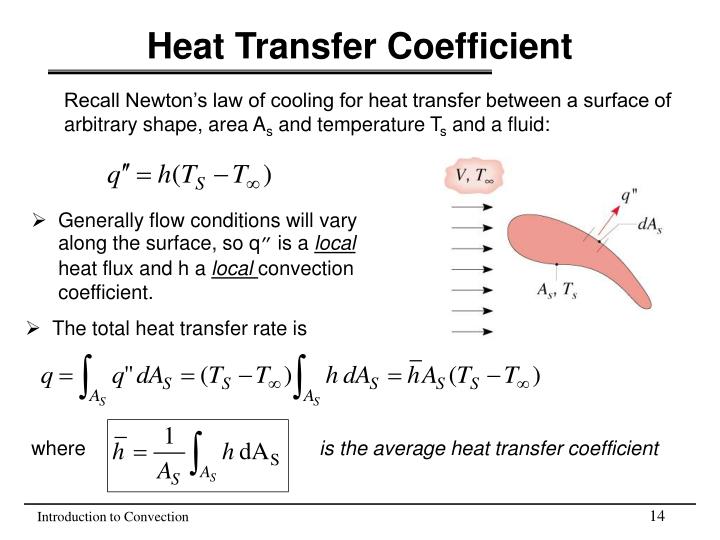
- Convection heat transfer coefficient
- noun
- h, can be defined as the rate of heat transfer between a solid surface and a fluid per unit surface area per unit temperature difference.
- es: Coeficiente de transferencia de calor por convección
- Critical Reynold’s number
- noun
- A critical Reynolds number is determined as a limit where the laminar flow changes to turbulent flow. If the calculated NRe is greater than the critical Reynolds number NRec, the flow regime is turbulent; otherwise the flow regime is laminar. For Newtonian fluids NRe of 2,100 is usually used as the critical Reynolds number. However, the value of the critical Reynolds number depends on the fluid behavior and properties.
- es: Número crítico de Reynolds

- Friction Coefficient
- noun
- it links the opposition to sliding offered by the surfaces of two bodies in contact according to the intensity of the mutual support they experience.
- es: Coeficiente de fricción

- Kinematic viscosity
- noun
- The kinematic viscosity of the lubricants, i.e. the quotient of dynamic viscosity and oil density, is a function of the temperature and is a major factor determining the level of noise generated by transmissions.
- es: Viscosidad cinemática

- Laminar flow
- noun
- Laminar flow occurs when the fluid flows in infinitesimal parallel layers with no disruption between them.
- es: Flujo laminar

- Nusselt number
- noun
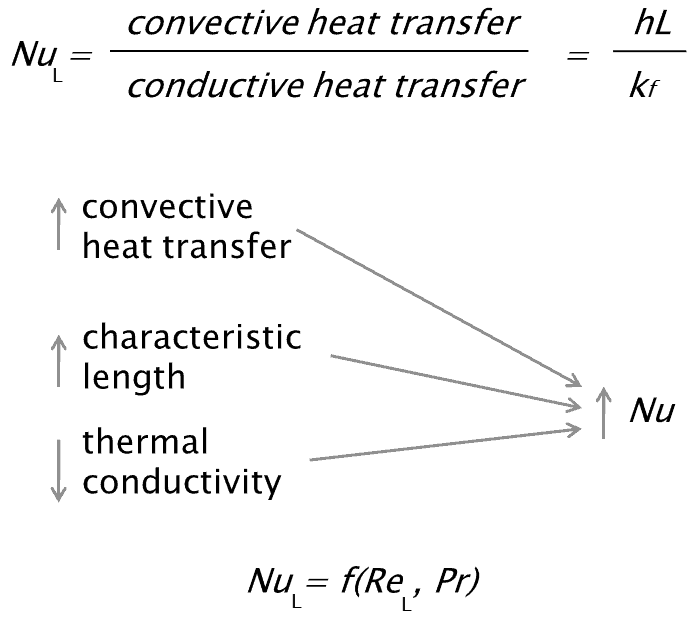
- is a dimensionless number, named for a German engineer Wilhelm Nusselt. The Nusselt number is closely related to the Péclet number and both numbers are used to describe the ratio of the thermal energy that is convinced to the fluid with respect to the thermal energy conducted within the fluid. The Nusselt number equals the dimensionless temperature gradient at the surface, and provides a measure of the convective heat transfer that occurs at the surface.
- es: Número de Nusselt
- Prandtl number
- noun
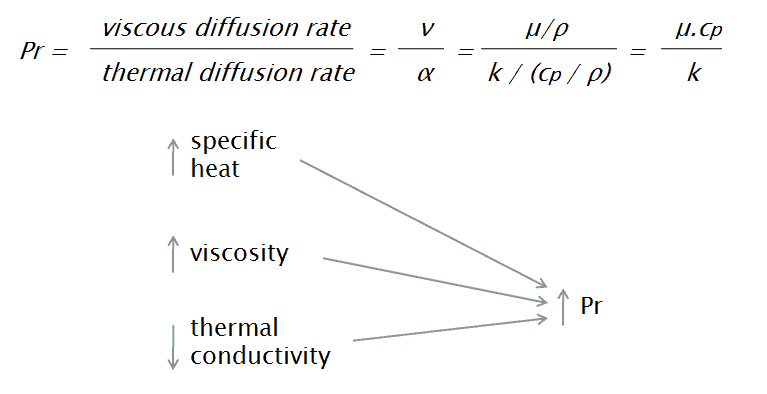
- it is a dimensionless number, named for its inventor, the German engineer Ludwig Prandtl, who also identified the boundary layer. The Prandtl number is defined as the ratio of impulse diffusivity to thermal diffusivity. Moment diffusivity, or as it is commonly called, kinematic viscosity, tells us the resistance of the material to shear flows (different layers of the flow travel with different speeds due, for example, to different speeds of adjacent walls) in relation to the density.
- es: Número de prandtl
- Reynold number
- noun
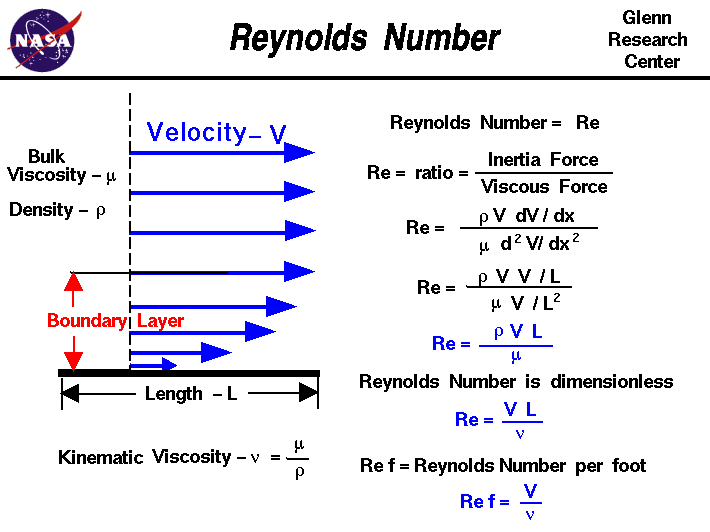
- The Reynolds number is the ratio of inertial forces to viscous forces. The Reynolds number is a dimensionless number used to categorize the fluids systems in which the effect of viscosity is important in controlling the velocities or the flow pattern of a fluid.
- es: Número de Reynold
- Shear stress
- noun
- force tending to cause deformation of a material by slippage along a plane or planes parallel to the imposed stress. The resultant shear is of great importance in nature, being intimately related to the downslope movement of earth materials and to earthquakes. Shear stress may occur in solids or liquids; in the latter it is related to fluid viscosity.
- es: Esfuerzo cortante

- Turbulent flow
- noun
- In turbulent flow, the velocity of the fluid at a point undergoes continuous changes in both magnitude and direction. The flow of wind and rivers is generally turbulent in this regard, even if the currents are gentle. Air or water swirls and swirls as its overall mass moves in a specific direction.
- es: Flujo turbulento
